

If you drive a pickup in Southwest Louisiana, you already know the drill: long hauls to job sites in Sulphur or DeRidder, weekend runs to Toledo Bend, stop-and-go on Ryan Street, and the occasional sprint out of town when a storm rolls in from the Gulf. Fuel costs add up fast when your truck is doing all of that.
That's exactly why hybrid pickups are turning more heads in 2026. They promise real-world fuel savings without asking you to give up the capability you depend on. But are they actually worth it for drivers around Lake Charles? The answer depends on how you use your truck.
Why Hybrid Pickups Are Getting So Much Attention in 2026
A few years ago, "hybrid truck" sounded like a contradiction. That's changed. Automakers have spent years engineering hybrid systems built specifically for trucks, and the result is a new generation of pickups that deliver genuine fuel savings without sacrificing the towing and payload numbers working drivers depend on.
Gas prices remain unpredictable, which hits hard if you're commuting regularly between Lake Charles and Beaumont, Port Arthur, or Lafayette. Hybrid technology has also matured significantly - early reliability concerns have given way to solid long-term ownership data. And for drivers doing a mix of city and highway miles, which describes most people in this area, hybrid efficiency shows up exactly where it counts.
The Real Benefits for Southwest Louisiana Drivers
Hybrid systems recover energy when you brake and decelerate, so stop-and-go traffic actually works in your favor. If your daily drive involves Lake Charles city streets or the Route 14 corridor into Sulphur, you're in the sweet spot for hybrid efficiency.
On job sites, some models like the Ford F-150 PowerBoost Hybrid include a built-in generator that runs power tools and equipment directly from the truck - a real advantage for contractors working around Calcasieu Parish or out in DeRidder who'd otherwise haul a separate generator. For family hauling, weekend runs to Sabine Lake, or supply trips to Orange or Beaumont, the fuel savings accumulate without any change in how you drive.
Fuel Economy vs. Towing and Payload: The Honest Tradeoff
Hybrid pickups offer a meaningful improvement in fuel economy over comparable non-hybrid trucks, especially in mixed driving. A compact hybrid like the Ford Maverick Hybrid can hit estimated EPA ratings in the low-to-mid 40s mpg in city driving. A full-size option like the F-150 PowerBoost sees more modest gains, but still delivers better numbers across the board. For a driver putting 15,000 to 20,000 miles a year on their truck, that's real money over time.
The honest caveat: if heavy towing is a daily requirement, check the numbers carefully. Hybrid systems add some weight, which can affect payload ratings. If you tow a loaded flatbed every day for work, a traditional gas or diesel config may still be the better tool. If you tow a fishing boat to the Calcasieu Ship Channel a few times a month, a hybrid handles that without issue. The sweet spot is a driver who needs a capable, versatile daily truck with towing and hauling as occasional demands–and that describes a lot of buyers around Lake Charles.
Compact Hybrid vs. Full-Size Hybrid: Which Fits Your Life?
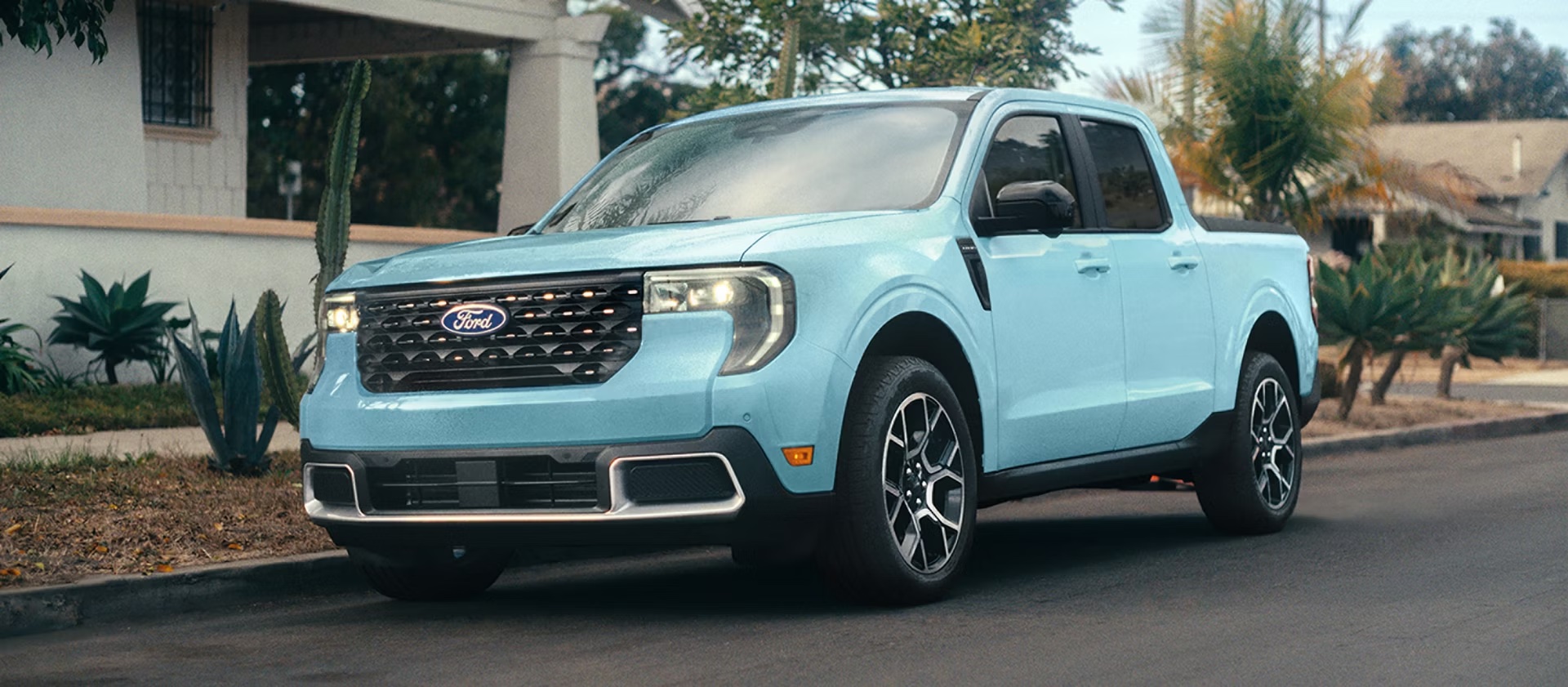
A compact hybrid like the Ford Maverick Hybrid is built for drivers who want truck utility without full-size running costs. It parks easier around Lake Charles, delivers sedan-rivaling fuel economy, and handles personal and family hauling without issue. It's the right call if you don't regularly tow heavy loads and want the lowest fuel costs in a truck body.
A full-size hybrid like the F-150 PowerBoost gives you genuine work-truck capability with better efficiency layered on top–serious towing, heavy payload, on-board power generation, and the range to handle regular runs between Lake Charles, Lafayette, Beaumont, or Port Arthur. It costs more upfront, but for high-mileage drivers who need a capable daily truck, the efficiency gains compound over time.
How Southwest Louisiana's Climate Affects the Decision
Lake Charles summers are brutal, and battery performance in heat is a fair question. Modern hybrid truck batteries are engineered for extreme temperatures and include active thermal management systems that regulate battery temperature regardless of external conditions. More importantly, hybrid systems supplement the gas engine rather than replace it–unlike a fully electric vehicle, a hybrid will never leave you stranded because the battery is depleted or overheated.
Hurricane season is the other factor that matters more here than almost anywhere else. When a storm threatens and you're heading to Baton Rouge or Houston, hybrid trucks fill up at any gas station along I-10 or I-12 just like a conventional truck. Better fuel economy is actually an advantage during evacuation, when stations along major routes can run out of fuel quickly. And for flooding concerns, hybrid trucks carry the same ground clearance and wading capability as their conventional counterparts–the hybrid powertrain doesn't add flood risk.
Questions to Ask Before You Buy
What does a typical week of driving look like? City and suburban miles are where hybrid efficiency shines most. Long highway hauls still save fuel, just more modestly.
How often do I tow, and how heavy? Know your actual towing weight before you shop. Compare the hybrid's rated tow capacity directly against what you pull, not a rough estimate.
How long do I plan to keep this truck? Hybrids often cost more upfront. The longer you own it, the more fuel savings compound against that difference.
What's my annual mileage? Higher mileage means more savings per year, which considerably shortens the payback period for a hybrid powertrain.
Frequently Asked Questions
Do hybrid trucks need to be plugged in?
No. Most hybrid trucks, including the Ford Maverick Hybrid and F-150 PowerBoost, are standard (non-plug-in) hybrids. They charge automatically through regenerative braking and the engine. You fill up at a regular gas station, same as a conventional truck.
Will a hybrid truck handle towing my boat or camper?
It depends on the truck and what you're towing. A compact hybrid has a more limited capacity than a full-size hybrid. A full-size hybrid like the F-150 PowerBoost can handle substantial loads. Always compare the truck's rated tow capacity against the actual weight of what you plan to pull.
Are hybrid trucks harder or more expensive to maintain?
Generally, no. The engine, transmission, and mechanical systems are the same as conventional trucks. Hybrid-specific components are largely self-maintaining, and brake wear is often reduced because regenerative braking handles much of the work.
Can I get a hybrid truck serviced locally?
Yes. Bolton Ford at 1500 East College Street in Lake Charles services Ford vehicles, including hybrid models. Call (337) 474-0070 with any questions.
So, Are Hybrid Pickups Worth It for Lake Charles Drivers?
For most drivers in Southwest Louisiana, the honest answer is yes–with the right expectations. If you use your truck as a daily driver, mix city and highway miles, and tow or haul occasionally rather than constantly, a hybrid delivers real value. The technology is mature, the capability is legitimate, and the ownership experience is not meaningfully different from a conventional truck.
If you rely on maximum tow ratings every day, a traditional gas or diesel configuration may still be the better choice. That's not a knock on hybrids–it's just honoring a better match between the truck and the task. Most drivers around Lake Charles, Sulphur, Jennings, and DeRidder fall somewhere in the middle, and that's exactly who hybrid trucks were built for.
Ready to explore your options? Stop by Bolton Ford at 1500 East College Street, Lake Charles, Louisiana 70607, or call (337) 474-0070. The team can walk you through hybrid and conventional lineups so you can make the call that fits your life. We serve drivers across Lake Charles, Sulphur, Orange, Beaumont, Port Arthur, and Lafayette.
Categories:
New Inventory